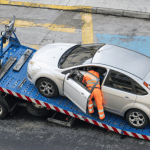
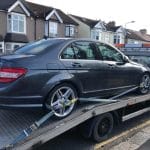
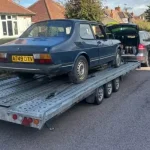
Moving a classic is not a harder version of moving a modern car. It is a different job, because the things that make it valuable — low clearance, original panels, delicate chrome, and often no ability to drive itself — are precisely the things a standard load can damage.
DK’s Recovery transports vehicles from Sheffield across the country — see vehicle transportation. Call 07867 860723.
The clearance problem
A standard tilt bed presents an angle that a modern hatchback clears comfortably and a low car does not. Front splitters, exhausts, sump guards and sills all meet the ground at the transition point where the ramp meets the road.
The answer is a shallower approach and patience: a bed set at the lowest angle it will take, ramp extensions to lengthen the run, boards under the transition if needed, and a slow winch rather than driving the car aboard under its own power.
None of that is exotic. It just takes time, and time is what gets skipped when a job is quoted as though it were any other car.
Wheel straps, not chassis straps
This is the single most important thing to ask about, and it is the difference between arriving as you left and arriving with a bill.
Wheel straps loop over the tyres and pull the car down onto its own suspension. The load goes through the wheels, which is what they are for. Nothing touches paint, chrome, sills or subframes.
Chassis straps put the load through whatever they are hooked to. On a modern car with proper recovery eyes that is often fine. On a classic, where the “chassis” may be a sixty-year-old bracket, a rusty sill or a suspension arm never designed for the load, it is where damage comes from.
Ask the question directly before booking. Anyone competent will answer it without hesitation.
Open or enclosed?
Enclosed protects against weather, road salt and stone chips thrown up on a motorway. Worth it for a concours car, a winter journey, a long run, or anything freshly painted.
Open is fine for a short dry run to a specialist or an MOT, and it costs considerably less. A properly loaded open transporter is not a compromise for most jobs — the compromise is a badly loaded one of either type.
The honest answer depends on distance, weather and what the car is worth to you. Anyone insisting enclosed is the only acceptable option for every job is selling rather than advising.
Non-runners
Most classic moves involve a car that will not start, or will not be started deliberately.
That means winching rather than driving on, and if the steering is locked or it will not come out of gear, skates underneath as well. All perfectly routine, but it takes longer and needs mentioning at booking rather than on arrival.
If the car has been standing a long time, say so. Seized brakes and flat-spotted tyres change how it behaves on the bed.
Before it goes on the truck
- Photograph it from every angle, in daylight, before loading. Not because anything will happen, but because a shared record means neither side is relying on memory.
- Note the fuel level and roughly the mileage.
- Remove anything loose inside — tools, spares, paperwork.
- Say if the handbrake should not be used, which is true of plenty of older cars left standing.
- Mention any known weakness — a sill you would rather nothing rested on, a jacking point that has seen better days.
What to ask before you book
How will it be secured, and do you use wheel straps? What angle does the bed set to? Are you insured for a vehicle of this value? Does the same driver collect and deliver? Can you send a photograph of it loaded before you set off?
Five questions. Anyone who finds them irritating has answered them.
Common questions
Can a low car be loaded without grounding?
Yes, with the right approach. A tilt bed at a shallow angle, ramp extensions to lengthen the approach, and a slow controlled winch rather than driving it on. What causes damage is a steep bed and a driver in a hurry.
Should straps go over the wheels or the chassis?
Over the wheels, in almost every case. Wheel straps pull the car down onto its own suspension and put no load through the chassis, subframes or body. Chassis strapping is where bent brackets and cracked sills come from.
Do you need an enclosed transporter for a classic?
Not always. Enclosed transport protects against weather, road salt and stone chips and is worth it for a concours car or a long winter journey. For a short dry run to a specialist, a properly loaded open flatbed is usually fine and considerably cheaper.
Can you move a classic that does not run?
Yes. A non-runner needs winching rather than driving on, and if the steering is locked or it will not come out of gear it needs skates as well. Say so when booking – it changes the time allowed for the job.
What should I ask a transporter before booking?
How the car will be secured, whether they use wheel straps, whether the bed angle suits a low car, whether they are insured for the vehicle’s value, and whether the same driver does collection and delivery. Reasonable questions, reasonably answered by anyone competent.
Do you cover long-distance classic transport?
Yes – shows, auctions, specialists and private sales across the country. Longer runs are quoted on the round trip, and it is worth booking ahead for a fixed date rather than at short notice.
Moving something worth looking after?
Tell us what it is, whether it runs, and how low it sits. 07867 860723.