It is a very specific kind of stranded. The car is fine. The spare is fine. The jack is in the boot. And the one small piece of metal that lets you undo four nuts is not anywhere you have looked twice.
Locking wheel nut keys go missing constantly, and they usually go missing at the exact moment they are needed, because that is the only moment anybody thinks about them.
What the key actually is
One nut on each wheel is not a normal hexagon. It has a pattern cut into its face — splines, notches, a spiral — and the key is a short socket adaptor machined to match. Slot the adaptor over the nut, put the wheel brace or a socket on the adaptor, and it undoes like any other nut. Without it, nothing standard will grip.
The pattern is not unique to your car. It is one of a set the manufacturer used, identified by a number, and that number is what makes a replacement possible.
Look properly before you conclude it has gone
Most missing keys are not missing. They are in one of half a dozen places, and people check two of them.
The boot toolkit with the jack. The spare wheel well, underneath the wheel rather than on top of it. The glovebox, right at the back. The door pockets. Under the front seats. The centre console tray. On cars supplied without a spare, the sealant and compressor kit — the key is very often clipped in with that, and it is the least intuitive place to look.
If you bought the car used, also consider that the last owner may have left it with a garage after a tyre change, which is where a large number of them end their lives.
Ordering a replacement
If you can find the key number, this is straightforward. It is stamped on the key or printed on the card or plastic fob that came with the car, often in the handbook wallet. A franchised dealer or the wheel nut manufacturer will supply a replacement adaptor against that number.
If the number is gone too, it depends on the make. Some manufacturers can look the set up against the VIN. Some cannot, or the record does not survive a change of ownership. If nobody can identify the pattern, the nuts have to come off the hard way.
Removal, and why it is a workshop job
The tool is an extractor socket — hardened, reverse threaded, driven onto the locking nut with a hammer so it cuts in and grips, then wound off. It destroys the nut, which is fine, because you replace the set afterwards.
What it needs is leverage, room to swing, and the nut not being seized solid into the wheel. On a car that has done a Sheffield winter or ten, that last condition is not guaranteed. Alloy wheels can also be damaged by someone doing this badly, and a scarred wheel costs considerably more than the nuts did.
None of that is a roadside procedure. It is a job for somewhere with the car on a ramp, proper tools and daylight.
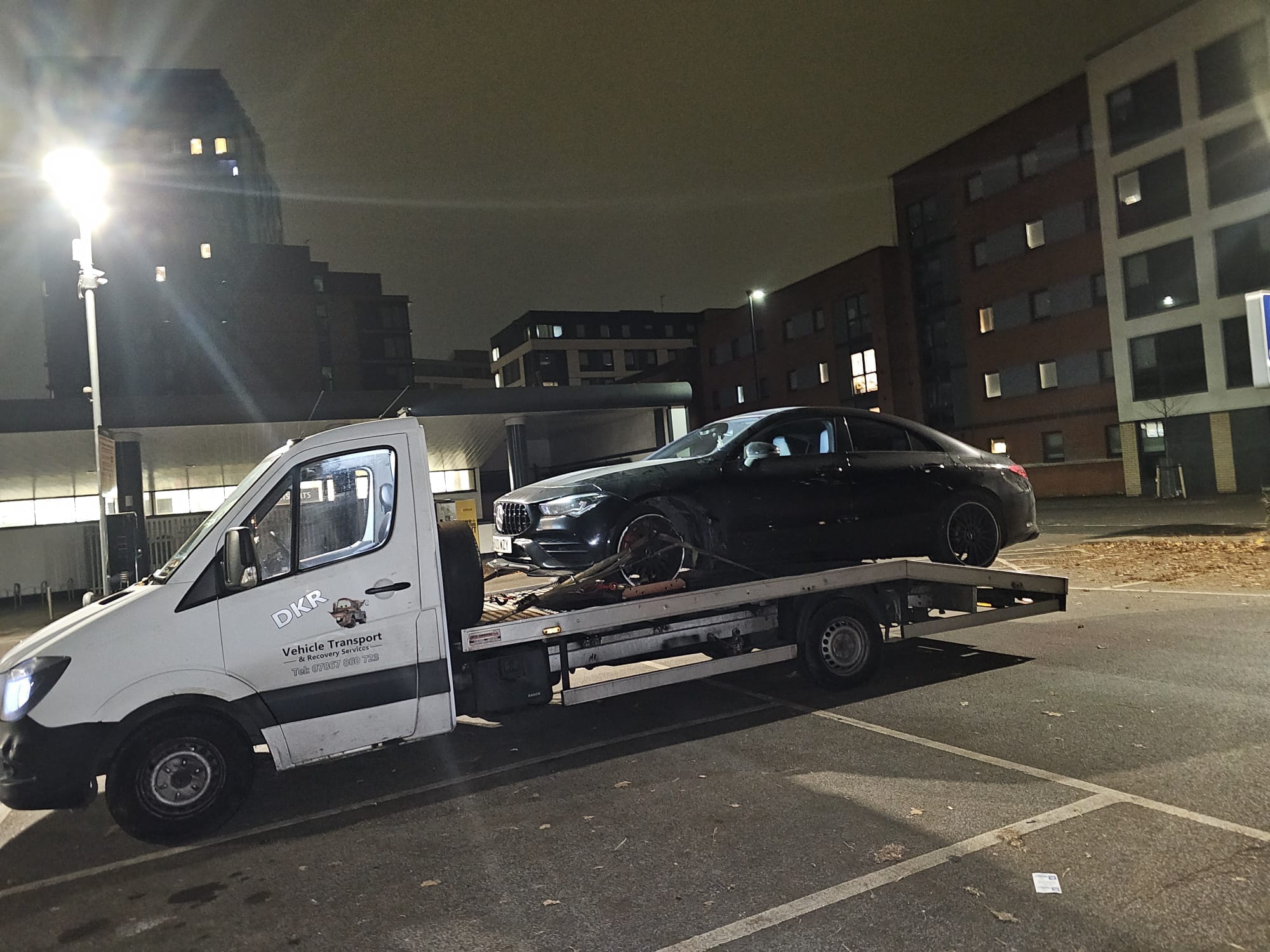
Where it is worth calling us: when the wheel will not come off and the car cannot be driven — a puncture, a blowout, a wheel that has to come off before anything else can happen. A flatbed does not care whether the nuts undo. We move it to a garage that can extract the nut properly, anywhere in Sheffield and South Yorkshire, at any hour. Call DK’s Recovery on +44 7867 860723.
The situations where it actually bites
A puncture away from home. This is the classic. You have everything you need except the adaptor, so the spare stays in the boot. Our guide to when a flat tyre needs recovery rather than a wheel change covers the decision, and the missing key removes the choice entirely.
A blowout. Worse, because the tyre is destroyed and driving on is not an option. What to do after a blowout sets out the sequence, and again it ends at the same place if the wheel cannot come off.
Booked work that needs a wheel off. Brakes, suspension, a tyre change. The garage rings you an hour into the day to say they cannot get the wheel off, and the job does not happen.
Anyone driving the car who is not you. A partner, a son or daughter at university, a member of staff in a works van. They will not know where the key lives, because you did not tell them.
Two minutes that prevent all of it
Find the key now, while the car is on the drive and nothing is wrong. Put it in one obvious place and leave it there — the boot toolkit is the sensible home, because that is where somebody with a flat tyre will look first.
Photograph the key number and keep the photo on your phone. If the adaptor is ever lost, that photo is the difference between ordering a part and paying someone to destroy four nuts.
Tell whoever else drives the car where it is. And if you have just bought the car and cannot find one at all, sort it before you need it rather than on a hard shoulder — the same principle that runs through our guide to what to do when your car breaks down.
Frequently asked questions
Where is the locking wheel nut key usually kept?
In the boot with the jack and the tools, in the spare wheel well, in the glovebox, in a door pocket, under a seat, or in the little tray in the centre console. On cars with no spare wheel it is often tucked in with the tyre sealant kit, which is the place people forget to look. If the car was bought used, check every one of those before assuming it is gone.
Can I get a replacement locking wheel nut key?
Usually yes, if you have the key number. It is stamped on the key itself or printed on a small card or fob supplied with the car, and a dealer or the wheel nut manufacturer can supply a replacement against that number. Without the number some manufacturers can look it up against the VIN, and some cannot, which is when removal becomes the route instead.
Can a tyre fitter change my wheel without the key?
Generally not. A mobile fitter turning up to a puncture needs the wheel off, and without the key the wheel stays on. Some fitters carry extraction tools, many do not, and a roadside verge in the dark is a poor place to start drilling into a wheel nut.
How is a locking wheel nut removed without the key?
With an extractor socket, which is a hardened reverse-thread socket hammered onto the nut so it bites into it and can be wound off. It destroys the nut, and it needs space, leverage and someone who has done it before. On a seized or badly rounded nut it can turn into a longer job, which is why it belongs in a workshop rather than at the roadside.
Will my car fail its MOT without a locking wheel nut key?
The standard car MOT does not involve taking the wheels off, so a missing key is not a fail on its own. It becomes a problem the moment any work is needed that does require the wheel off, which includes most brake work, and a garage that cannot get the wheel off cannot do the job you booked.
Can a car with a flat tyre and no key still be recovered?
Yes. A flatbed does not need the wheel to come off, only to roll or be winched, and a deflated tyre on a rim will usually manage the short distance onto the bed. That is the normal answer when the key is missing and the car cannot be driven.