Scrapping a car is one of those jobs that looks like it should take five minutes and occasionally goes wrong for years. The mechanics of it are simple. The paperwork is where people stay liable for a vehicle they gave away in 2021.
It has to go to an Authorised Treatment Facility
An ATF is a scrapyard or breaker’s licensed to dispose of end-of-life vehicles properly, and it is the only kind of place you should hand a car to. They are the ones who can issue the document that proves the car is gone.
Scrapping is usually free. You may be charged if essential parts have already been removed — no engine, no gearbox — because the vehicle is then worth less as material than it costs to process.
You can check whether a yard is an ATF before you commit. The public register of Authorised Treatment Facilities is available online, and a legitimate operator will not mind being asked.
The Certificate of Destruction
This is the document that matters. The ATF issues a Certificate of Destruction to prove the vehicle has been destroyed. Get it, keep it, and do not leave without knowing when it will be issued.
The Certificate of Destruction is the thing that ends the story. It is what tells DVLA the vehicle no longer exists, and it is what protects you from a speeding ticket in 2028 for a car you last saw four years earlier.
The V5C, and the bit everyone gets wrong
Give the ATF the log book — but keep the yellow section, the part headed “sell, transfer or part-exchange your vehicle to the motor trade”. That slip is your evidence, and it is the piece people habitually hand over with the rest.
Then tell DVLA you have taken the vehicle to an ATF. This is a legal requirement, not a courtesy. You can be fined £1,000 if you do not tell DVLA.
If you have lost the V5C entirely, that does not stop you scrapping the car, but it does make it more important to notify DVLA yourself and to keep whatever the ATF gives you.
Getting it there when it does not run
Most cars that reach this point do not drive, and a scrap value of very little should not be spent on a mistake at the last minute.
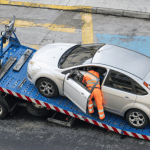
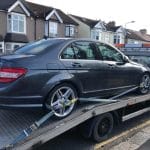
A vehicle with no MOT, no tax or no insurance cannot lawfully be driven to a scrapyard. It has to be carried. Many ATFs will collect, and if the yard is collecting, let them.
Where it is worth calling us instead: when the car cannot be dragged onto a lorry because the brakes have seized or a wheel is locked, when it is somewhere a large collection vehicle cannot get to, or when you want it taken to a specific yard rather than whichever one turns up. We move non-runners on a flatbed across Sheffield and South Yorkshire — call DK’s Recovery on +44 7867 860723. Our guide to cars that have stood for months covers why so many of them will not roll.
Empty it properly first
Once it has gone, it has gone. The documents in the glovebox, the parking permit on the windscreen, the toll tag, the sunglasses, the child seat, the contents of the boot, anything in the spare wheel well. Take the plates off if you are retaining the registration — that is a separate process with DVLA and it has to be done before the car is scrapped, not after.
And cancel things. The insurance, any breakdown policy tied to the vehicle, the direct debit for the tax. A refund on remaining tax is issued automatically once DVLA is told.
Is it actually worth scrapping?
Sometimes not, and it is worth ten minutes of thought.
A car with a failed engine but good bodywork and a fresh MOT may be worth more to a private buyer or a breaker as a repairable vehicle than as scrap metal. Our guide to engine failure and whether to repair or scrap works through that arithmetic properly.
At the other end, a car with a valid MOT and a small fault is very often worth repairing rather than replacing, once you price what the replacement would actually cost.
A note on cash
It is illegal in England and Wales for a scrap metal dealer to pay cash for scrap, under the Scrap Metal Dealers Act 2013. Payment should be by bank transfer or cheque, traceably. A yard offering you notes for a car is telling you something about how it operates, and any yard that will not give you a Certificate of Destruction should be walked away from regardless of what it is offering.
Frequently asked questions
Where can I legally scrap my car?
At an Authorised Treatment Facility, which is a scrapyard or breaker’s licensed to dispose of end-of-life vehicles. They are the only places that can issue a Certificate of Destruction. The public register of ATFs is available online if you want to check first.
What is a Certificate of Destruction?
The document issued by an Authorised Treatment Facility to prove the vehicle has been destroyed. It is what ends your liability for the car, so get it and keep it.
What do I do with the V5C?
Give the log book to the ATF but keep the yellow section headed sell, transfer or part-exchange your vehicle to the motor trade. That slip is your evidence, and it is the part most people hand over by mistake.
Do I have to tell DVLA I have scrapped my car?
Yes, it is a legal requirement to tell DVLA you have taken the vehicle to an ATF, and you can be fined £1,000 if you do not. Notifying them also triggers the automatic refund of any remaining vehicle tax.
Can I drive it to the scrapyard?
Only if it is taxed, insured and has a valid MOT. If any of those are missing it has to be carried. Many ATFs will collect, and where the car will not roll or is somewhere a large collection lorry cannot reach, a flatbed is the answer.
Can a scrapyard pay me in cash?
No. Under the Scrap Metal Dealers Act 2013 it is illegal for a scrap metal dealer in England and Wales to pay cash for scrap. Payment should be traceable, by bank transfer or cheque.