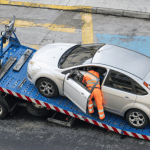
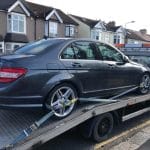
A car that will not start in a city-centre multi-storey is a different problem from the same car on a street. The fault is usually trivial. Getting a recovery vehicle to it is not.
DK’s Recovery covers Sheffield city centre 24 hours a day. Tell us the car park and the level when you call. 07867 860723, or see our vehicle recovery page.
The height barrier decides everything
Most multi-storeys have a clearance of roughly 1.9 to 2.1 metres. A flatbed recovery truck, empty, is well over three. It is not a question of being careful — the vehicle physically cannot enter.
So recovery from inside a car park means one of three things: low-clearance equipment that can get under the barrier, skates to manoeuvre the car out to a point where a truck can reach it, or getting the car to the entrance under its own power or by hand first.
Why “which level” is the first question
It is not small talk. The level determines how many ramps sit between the car and daylight, and ramps in older multi-storeys are steep and tightly curved. Moving a non-running car down two spiral ramps is a considerably bigger job than moving it across a flat top deck.
Roof level, oddly, is sometimes the easiest — open sky, no height limit above, and occasionally an accessible edge. Lower ground is usually the hardest.
Can you push it out yourself?
Only if it genuinely rolls, steers and comes out of gear — and only with enough people, on a level surface, going somewhere sensible.
What people underestimate is the ramps. A car with no engine has no power steering and no servo assistance to the brakes, which means it is heavy to steer and needs far more effort to stop than expected. A vehicle getting away on a downward ramp is a genuinely serious incident, and it happens.
If in any doubt, leave it where it is. A car parked awkwardly costs parking charges. A car that has run into a pillar costs considerably more.
When the car will not move at all
A car with no key has a locked steering column and, if automatic, a transmission stuck in park. The wheels will not turn, so it cannot be pushed or towed conventionally.
That is what skates are for — low wheeled dollies that slide under the locked wheels so the vehicle can be steered by hand to somewhere a truck can reach it. Slower, and the reason it matters that you mention there is no key when you call.
Underground is usually worse
Lower clearance, steeper ramps, tighter turns and poorer ventilation. If the car is in an underground car park rather than a multi-storey, say so specifically — the two get used interchangeably and they are not the same job.
One thing worth separating out: a car that is not where you left it has usually been towed away rather than stolen, and there is a specific order of calls that finds it quickest.
The charges running in the background
Almost every operator charges by the hour regardless of why your car is still there, and a broken-down vehicle earns no sympathy from a barrier system. On a city-centre stay that accrues quickly.
It is worth telling the car park office what has happened — some will note it, and it is easier to discuss the bill with a record of the breakdown than without one.
What to tell us
- Which car park, by name.
- Which level, and whether it is above or below ground.
- The height limit at the entrance if it is signed.
- Whether the car rolls, steers and comes out of gear.
- Make and model, and whether it is automatic or electric.
- Where it needs to go afterwards.
Six answers and we arrive with the right equipment. Without them, the likely outcome is a truck that cannot get in and a second visit.
Common questions
Can a recovery truck get into a multi-storey car park?
A conventional flatbed almost never can. Most multi-storeys have height barriers around 1.9 to 2.1 metres, and a loaded flatbed is far taller than that. Recovery from inside is done with low-clearance equipment, skates, or by moving the car to the entrance first.
What is the first thing you need to know?
Which car park and which level. Those two facts decide the whole job – the height limit, the ramp gradient, whether there is a lift, and whether the vehicle has to be brought up or down before anything else happens.
Can the car be pushed out instead?
Sometimes, if it rolls, steers and comes out of gear, and if the levels between you and the exit are manageable. Ramps in older car parks are steep and this is not a job for one person – a car running away on a spiral ramp is a serious incident.
What if the car will not come out of gear or the steering is locked?
Then it cannot be pushed and needs skates – small wheeled dollies that go under the locked wheels so it can be manoeuvred. That is standard for a car with no key, a seized wheel or an automatic stuck in park.
Will I be charged for the time the car has been parked?
Almost certainly, and that is between you and the car park operator. Most charge by the hour regardless of why the car is still there, which is why deciding quickly is worth money on a stuck vehicle in a city-centre multi-storey.
Do the same problems apply to underground car parks?
Yes, and often worse. Height limits are frequently lower, ramps steeper, ventilation poorer and turning circles tighter. Tell us it is underground rather than multi-storey, because the approach differs.
Stuck in a Sheffield car park?
Tell us the car park and the level. 07867 860723 — 24 hours a day.
Height barriers are the most common reason a lorry cannot simply drive to your car, but they are not the only one. Our guide to why a recovery truck cannot always reach you covers weight limits, narrow streets, gated sites and soft ground.