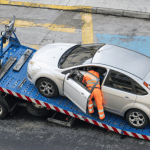
Sheffield sits at the meeting of five rivers, and the Don valley has flooded seriously twice in living memory. Every heavy autumn downpour puts standing water across roads that are usually fine. This is what to do if you have driven into it — and the answer starts with something not to do.
Do not restart the engine. DK’s Recovery covers Sheffield and South Yorkshire 24 hours a day. Call 07867 860723, or see our breakdown recovery page.
Why restarting is the mistake
Engines work by compressing air. Water does not compress. If water has been drawn in through the air intake, then the moment the piston rises against a cylinder full of it, something has to fail — usually a connecting rod bending or breaking, sometimes the block itself.
That is hydrolock, and it is one of very few faults that can destroy an engine in a single revolution. The crucial detail: it almost always happens on the restart, not in the water. A car that stalled in a flood and was left alone is frequently repairable. The same car, cranked twice by an optimistic owner, often is not.
If you are in the water now
- If the car is still moving and you can get out of the water, keep going steadily rather than stopping.
- If it has stalled, do not turn the key.
- Get out if the water is rising, and move to higher ground. The vehicle is replaceable.
- If water is deep enough to be moving the car, get out of it — a floating car goes where the water goes.
- Call 999 if anyone is trapped or the water is rising quickly.
How little water it takes
The numbers surprise people. Around ten centimetres of moving water is enough to cause loss of control. Roughly thirty is enough to float many cars — and once a car floats it has no steering and no brakes in any meaningful sense.
Most manufacturers put the safe wading depth around the bottom of the door sill, and the air intake on plenty of cars sits lower than the bonnet suggests. A puddle that looks like nothing at the roadside can be considerably deeper in the middle, particularly where a road dips under a bridge.
The other hazard is what you cannot see: a lifted drain cover, a washed-out edge, or debris.
If you got through and the car seems fine
Still worth a check. Water gets into places that do not complain immediately.
Brakes can be briefly ineffective — dry them with light pressure while moving slowly once clear. Wheel bearings and differentials can take water past their seals and fail weeks later. Electrical connectors corrode quietly and show up as odd, intermittent faults down the line. And on modern cars, water in the cabin reaches control modules that are frequently mounted under seats.
A damp carpet after a flood is not a valeting problem. It is a sign of where else the water went.
Before the car is moved
Photograph it. The water level against the wheels and the door, the location, the road, and the time. Insurers treat flood damage differently from mechanical failure, and evidence of what actually happened is far easier to gather now than to argue for later.
Comprehensive policies generally cover flood damage — though an insurer may take a view where a driver deliberately entered standing water, and third-party cover will not pay for your own car at all.
Recovering it
Tell us the depth, whether the water is moving, and whether it is rising. Crew safety comes ahead of the vehicle, and a car sitting in rising water sometimes has to wait until it is safe to approach.
Once it is out, it goes to a garage rather than being started. Whether the engine survived is a question for someone with the plugs out and a compression tester, not for the ignition key.
Common questions
My car went through flood water and stalled. Can I restart it?
No. That is the single most important thing on this page. If water has been drawn into the engine it cannot compress, and turning it over can bend a connecting rod or crack the block – damage that happens on the restart rather than in the water itself.
How deep is too deep?
Far shallower than most people assume. Around 10cm of moving water can cause loss of control, and roughly 30cm is enough to float many cars. Most manufacturers put the safe wading limit near the bottom of the door sill, and the air intake on many cars is lower than the bonnet line.
What is hydrolock?
Water entering a cylinder through the air intake. Air compresses and water does not, so when the piston rises against a cylinder full of water something has to give – usually the connecting rod. It is one of the few faults that can write off an engine instantly.
My car went through water and seems fine. Should I still get it checked?
Yes. Water in the brakes, wheel bearings, differentials and electrical connectors causes problems over the following days and weeks rather than immediately. Corrosion in connectors in particular shows up as odd electrical faults later.
Will my insurance cover flood damage?
Comprehensive policies usually cover flood damage, but insurers may take a different view where a driver knowingly drove into standing water, and third-party-only policies will not cover your own vehicle. Photograph the water level and the location before the car is moved.
Can you recover a car from flood water?
Yes, and it should not be driven or restarted first. Tell us the depth, whether the water is moving, and whether it is rising – crew safety comes before the vehicle, and a car in rising water may have to wait until it is safe to approach.
Car in flood water in Sheffield?
Leave the key alone and get yourself somewhere safe. 07867 860723 — 24 hours a day.