Somewhere in your car there is a threaded socket, hidden behind a small plastic panel in the bumper, and a metal eye that screws into it. Most drivers have never seen either. They matter more than almost anything else in the boot, because the wrong attachment point is how a straightforward recovery turns into a bent suspension arm and an argument about who pays for it.
Where the eye actually is
On the great majority of cars sold in the UK, the towing eye lives with the jack and the wheelbrace. That is under the boot floor, in the spare wheel well, or in a foam tray where the spare used to be before manufacturers stopped fitting them. On some cars it is clipped inside the tool kit; on a few it is in a pouch under the passenger seat or behind a side panel in the boot.
It is a stubby metal bar, usually painted or plated, with a loop or a hole at one end and a coarse thread at the other. If you have never found yours, spend two minutes looking now rather than at the roadside in the dark. Cars change hands and the tool kit does not always come with them, and a missing eye is worth knowing about before you need it.
Where it screws in
Front and rear bumpers have a small removable panel, usually a square or circle a few inches across, held in by a clip. It often has a nick in one edge to prise it out with a screwdriver or the flat end of the wrenching tool. Behind it is the threaded socket, welded into the chassis structure so it can take a serious pull.
The thread on many cars is left-handed. That catches people out constantly. If it will not tighten the way you expect, try the other way before you assume it is cross-threaded. Screw it in fully and firmly by hand, then nip it up with the wrenching tool through the eye if there is room, because a half-engaged eye can strip under load.
Why the right point matters so much
A recovery eye is bolted into the car’s structure and designed to take a pulling load along the length of the vehicle. Almost nothing else under a modern car is. The things that look strong to an untrained eye are the ones that are not:
Suspension arms. Lower arms and wishbones look like obvious hooks. They are designed for vertical loads through a bush, not for a sideways drag, and they bend. A bent arm knocks the geometry out, ruins tyres, and is not always obvious afterwards.
Anti-roll bars and driveshafts. Both are round, both are accessible, both will be damaged by a winch strap.
Bumper beams and crash structures. They are meant to crush, not pull.
Tow bar balls. Fine for towing a trailer, not always rated for the shock loading of pulling a stuck car out of soft ground.
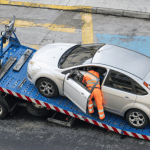
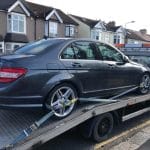
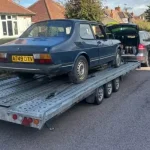
This is worth asking about when you book. An operator who asks where your recovery points are, or brings the right straps for a car with no eye, is telling you something about how they work. At DK’s Recovery we recover on a flatbed with wheel straps as standard, and where a winch is needed we use the vehicle’s designed recovery points. If you are not sure where yours are, tell us the make and model when you call on +44 7867 860723 and we will come prepared.
Cars that do not have one
Some vehicles have no screw-in eye at all. Certain vans, older 4x4s and some performance cars use fixed hooks or lashing points under the front and rear instead, and those are often labelled in the handbook rather than obvious under the car. Electric vehicles frequently have a single front eye and nothing at the rear, on the basis that they should be going on a bed anyway.
If your car has no eye and no accessible fixed point, that is not a problem — it changes the method rather than the possibility. It usually means going on a flatbed with wheel straps rather than being pulled anywhere, which is how we would move it in any case.
The eye is for recovery, not for towing
This is the distinction that causes most of the damage. The eye exists so a vehicle can be pulled a short distance at walking pace: off a verge, out of a bay, onto a bed. It is not a licence to rope your car home behind a friend’s.
Towing on a rope on a public road is legal within limits, but with a broken car it is very rarely wise. The brakes have no servo assistance with the engine off and go extremely heavy. The steering lock may engage. On an automatic it can destroy the gearbox, which is covered in our guide to why an automatic cannot be towed on its wheels. And a rope gives you no way to stop the car behind if the one in front brakes hard.
Underbody trays and where a jack goes
Two related things worth knowing at the same time. Many cars now have a plastic undertray covering the engine bay, and it will not take any load at all. And the jacking points are separate from the recovery points: reinforced sills, usually marked by an arrow or a notch in the plastic. Putting a trolley jack under a sill anywhere other than that point crushes it, and putting it under the sump is an expensive mistake.
If you are ever changing a wheel at the roadside, our guide on when a flat tyre needs recovery rather than a spare covers when to attempt it and when not to.
Two minutes, once
Find the eye. Check it is actually in the car. Find the bumper panel at the front and the back so you know which one comes out. Read the page in the handbook that shows the jacking points. That is the whole job, and it is a great deal easier on a driveway in daylight than on the A57 in February.
Frequently asked questions
Where is the towing eye on my car?
Usually with the jack and wheelbrace, under the boot floor, in the spare wheel well, or in a foam tool tray. On some cars it is under a passenger seat or behind a boot side panel. It is a short metal bar with a loop at one end and a coarse thread at the other.
Which way does a towing eye screw in?
On many cars the thread is left-handed, so it tightens anticlockwise. If it will not bite the way you expect, try the other direction before assuming it is cross-threaded, and make sure it is fully engaged, because a half-screwed eye can strip under load.
What happens if the recovery operator uses the wrong point?
Suspension arms bend, anti-roll bars and driveshafts get damaged, and crash structures deform because they are designed to crush rather than pull. The damage is not always obvious at the time and can show up later as ruined tyres or pulling steering.
My car does not have a towing eye. Can it still be recovered?
Yes. Some vans, 4x4s and performance cars use fixed lashing points instead, and many electric vehicles have only a front eye. Where there is no usable point, the car goes on a flatbed with wheel straps, which is how we would move most vehicles anyway.
Can I use the towing eye to tow my car home?
It is designed for short, slow recovery pulls rather than for towing on the road. With the engine off the brakes lose their servo assistance and go very heavy, the steering may lock, and on an automatic a tow can destroy the gearbox. In almost every case the car should be carried instead.
Where do I put a jack, and is that the same place?
No. Jacking points are reinforced sections of the sill, usually marked with an arrow or a notch in the plastic trim, and they are separate from the recovery points. A jack under any other part of the sill will crush it, and one under the sump will do far worse.