A tyre going down is the most common reason drivers stop unexpectedly, and the most common way a cheap problem turns into an expensive one. The whole thing hinges on two decisions: where you stop, and whether you drive on it.
DK’s Recovery covers Sheffield and South Yorkshire 24 hours a day for roadside assistance and breakdown recovery. Call 07867 860723.
The moment it goes
You will usually feel it before you see it — the steering pulling to one side, a rhythmic thumping, or the car feeling vague and heavy in corners. Ease off the accelerator rather than braking hard, keep a firm grip on the wheel, and look for somewhere to stop.
Where you stop matters more than stopping quickly. A few hundred metres at low speed to reach a side road, a lay-by or a car park is almost always better than stopping in a live lane — even though it will finish the tyre off.
Can you drive on it?
Flat: no. A completely flat tyre is destroyed in a few hundred metres, and once the rim is running on the road you risk the wheel, the sidewall and sometimes suspension components. What was a tyre bill becomes a tyre, a wheel and an alignment.
Slow puncture: only to get somewhere safe. If it is still holding some pressure, use that to get off a dual carriageway or out of a live lane, then stop. It is not a way of finishing the journey.
The spare, and its limits
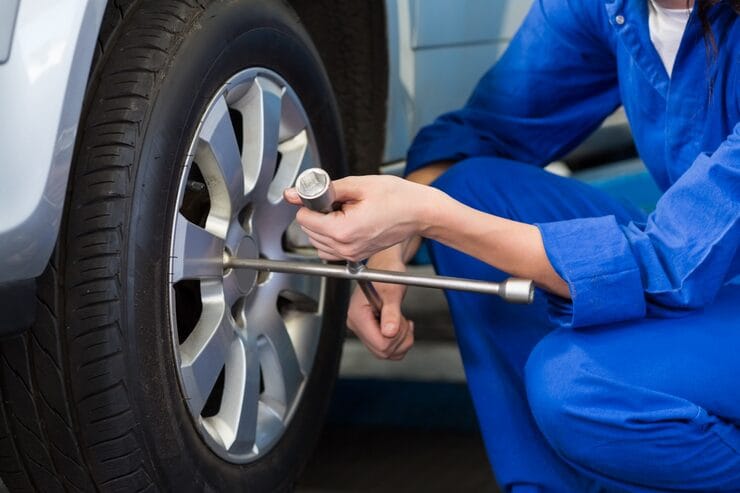
Fitting a spare is reasonable on a quiet residential street, on level ground, with the car well clear of traffic and the handbrake on. It is not reasonable on a verge on a slope, in the dark on a bend, or anywhere you would not comfortably stand for ten minutes.
Never change a wheel on a motorway hard shoulder or in a live lane. Get everyone out through the passenger doors, behind the barrier, and call for help. That applies on the M1 and on the Parkway.
If it is a space-saver, check the label on the wheel — usually 50mph and a limited distance. It is designed to reach a tyre fitter, not to continue your journey.
Repair kits: what they can and cannot do
Many cars now carry a sealant and compressor kit instead of a spare. They work on small punctures in the tread — a nail or a screw, still in place, in the middle of the tyre.
They will not fix a split sidewall, a cut or gash, a tyre that has come off the rim, or one already driven flat. Worth knowing: sealant can also make a later professional repair impossible, so a tyre that might have been repaired for a small sum sometimes has to be replaced instead.
When it needs recovery rather than a roadside fix
- Damage to the sidewall — a bulge, a cut or a split. Sidewalls cannot be repaired.
- The tyre has come off the rim, or the wheel is visibly buckled.
- More than one tyre is down.
- No spare and no usable repair kit.
- You are somewhere it is not safe to work — motorway, dual carriageway, a blind bend, a narrow lane.
- The tyre went down in a collision, or after a heavy kerb or pothole impact.
Kerb and pothole damage
Sheffield’s hills and older side streets do their share of wheel damage. An impact hard enough to deflate a tyre is often hard enough to buckle the rim, and a buckled rim will not seal against a new tyre. If the tyre went down suddenly after a bang, have the wheel checked as well — fitting a new tyre to a damaged rim just repeats the problem.
What to tell us when you call
- Where you are, and whether you are off the carriageway.
- Which wheel, and whether it is flat or losing pressure slowly.
- Whether you have a spare, a space-saver, or a sealant kit.
- Whether it followed a bang, a kerb, a pothole or a collision.
- Make, model, and whether there is a locking wheel nut key in the car.
That last one catches people out more than anything else — a missing locking wheel nut key turns a ten-minute job into a recovery.
If the damage came from hitting something rather than from wear, our guide to pothole damage and claims covers what to check and whether the council will pay.
Common questions
Can you drive with a flat tyre?
No. A completely flat tyre is destroyed within a few hundred metres and the rim then runs on the road, which can damage the wheel, the sidewall and sometimes the suspension. A cheap tyre change becomes an expensive one. Stop as soon as you safely can.
Can you drive on a slow puncture?
Only far enough to reach somewhere safe, and slowly. A slow puncture that is still holding some pressure will get you off a dual carriageway or out of a live lane. It will not get you home across the city, and driving it flat causes the damage above.
Is a tyre repair kit good enough?
Sometimes. The sealant kits fitted in place of a spare handle small punctures in the tread. They cannot fix a split sidewall, a large cut, or a tyre that has already been driven flat – and the sealant can make a professional repair impossible afterwards, so the tyre may need replacing regardless.
How fast can I drive on a space-saver spare?
Check the label on the wheel itself – it is usually 50mph, with a distance limit too. A space-saver is for getting to a tyre fitter, not for continuing your journey.
Should I change a wheel on the motorway?
No. Never change a wheel on a hard shoulder or in a live lane. Get everyone out through the passenger doors, behind the barrier, and call for recovery. This is true even if you have a full-size spare and have done it a hundred times.
My tyre went down after hitting a pothole. Is the wheel damaged too?
Often, yes. A kerb or pothole impact hard enough to deflate a tyre can also buckle the rim or split the sidewall, and a buckled rim will not hold a new tyre. Have the wheel checked rather than just replacing the tyre.
Tyre down in Sheffield?
Get off the carriageway first, then call. 07867 860723 — 24 hours a day. If it went suddenly at speed, read our guide to what to do after a blowout.
There is one thing that removes the choice entirely, and it is worth checking before you need it: a missing locking wheel nut key means the wheel does not come off at all, spare or no spare.
It is also worth knowing how old the tyre was to begin with. Our guide to tyre age, date codes and part-worn tyres explains where the date is moulded into the sidewall and why a low-mileage car can be running on tyres that are past their best.