Someone offers to tow you home on a rope. Your car is an automatic. The correct answer is almost always no, and the reason is worth understanding, because “it is only a couple of miles” is how people end up with a gearbox bill larger than the car is worth.
The mechanism, in one paragraph
An automatic gearbox is lubricated and cooled by fluid under pressure, and that pressure is produced by a pump. On the great majority of automatics that pump is driven by the engine. Engine off means pump not turning, which means no pressure and no circulating fluid.
Now tow the car with its driven wheels on the road. Those wheels turn the output side of the gearbox, so shafts, clutches and bearings inside are all spinning — being worked — with no oil being pumped to them. That is the damage. It is not the towing that hurts it; it is turning the internals without lubrication.
Why a manual is different
A manual gearbox is splash lubricated. Gears dip into oil in the bottom of the casing and fling it around as they turn, so a turning manual gearbox is lubricating itself whether the engine is running or not. That is why the same rope that is fine on one car is not fine on another.
It does not make towing a manual a good idea. With the engine off you have no brake servo, so the pedal goes very hard, and no power steering. But it will not destroy the gearbox.
“The handbook says I can”
Some handbooks do permit a short tow, and the conditions attached are the point. Typically they specify a low maximum speed, a short maximum distance, selector in neutral, and sometimes only for certain gearbox types. Those limits exist because the manufacturer has calculated how long the internals can survive unlubricated, not because they are being cautious.
Read your own handbook rather than a forum. And note that the permission, where it exists, is for getting a car off a carriageway or out of a bay — not for a journey.
Four-wheel drive is stricter again
On a four-wheel drive vehicle every wheel is connected to the drivetrain, so lifting two of them does not solve anything: the transfer case and centre differential are still being turned. Most 4×4 handbooks say all four wheels off the ground, full stop.
The same applies to many all-wheel drive cars that people do not think of as 4x4s at all — plenty of ordinary estates and SUVs drive all four wheels.
Electric and hybrid vehicles
Different reason, same answer. On an EV the motor is directly coupled to the driven wheels, so rolling the car turns the motor, and a turning motor generates current into a system that is not expecting it. Neutral disengages the parking pawl so the car can be pushed; it does not disconnect the motor.
Our EV recovery page covers this, and hybrids are the same on whichever axle the electric motor drives.
What a dolly does and does not solve
A dolly lifts one axle onto a small trailer. On a front-wheel drive automatic with the front wheels lifted, the driven wheels are off the ground and the gearbox internals are not being turned, so it can be a legitimate method.
The catches are that it has to be the driven axle that is lifted, it does not work on four-wheel drive, and on some cars the steering must be unlocked, which needs a key. It is a specialist judgement rather than a default.
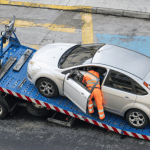
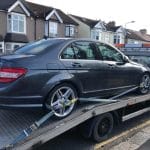
Which is why the answer is usually a bed. All four wheels off the ground removes the question entirely: nothing turns, nothing is being worked, and it does not matter whether the car is automatic, four-wheel drive, electric or has no keys at all. That is how we move vehicles as standard. Tell us it is an automatic when you call DK’s Recovery on +44 7867 860723 and it will be on a flatbed. Our vehicle recovery service covers the rest.
The other things that rule out a rope
Even on a manual, a tow is off the table if any of these apply, and they apply more often than people think:
No keys, or a locked steering column. A car that cannot be steered cannot be towed, and has to be winched.
A locked or seized wheel. A wheel that will not turn will drag, and destroys a tyre in yards.
Brake or suspension damage. If it will not stop or will not track straight, it should not be on the road behind another vehicle.
Accident damage. A car pulled by a bent structure is a car being bent further. Our guide to what happens after an accident covers how damaged vehicles get loaded.
Motorcycles are their own case again, with no wheels that can safely take a strap and a machine that has to be secured upright. Our guide to motorcycle recovery in Sheffield covers how a bike should be moved.
And a note on the rope itself
Towing on a public road has its own rules — the towed vehicle needs someone at the wheel who can steer and brake, the rope must not exceed the permitted length, and it should be clearly visible. But the real problem is not legality. It is that a broken car on a rope has heavy brakes, heavy steering, no way to signal properly and no way to stop if the car in front stops hard.
If it is your own car and the distance is fifty yards to get off a carriageway, that is one thing. As a way of getting home, it is a false economy in almost every case.
Frequently asked questions
Can you tow an automatic car?
Not on its driven wheels with the engine off, in almost all cases. The gearbox is lubricated by a pump driven by the engine, so with the engine off there is no oil pressure while the internals are being turned by the road wheels. That is what causes the damage.
Why can you tow a manual but not an automatic?
A manual gearbox is splash lubricated: the gears dip into oil and fling it around as they turn, so it lubricates itself whether or not the engine is running. An automatic depends on a pump that only turns with the engine.
My handbook says a short tow is allowed. Is that safe?
Where it is permitted, it comes with strict limits on speed and distance, and those limits reflect how long the internals can survive without lubrication. It is intended for getting a car off a carriageway or out of a bay, not for a journey. Follow your own handbook rather than general advice.
What about four-wheel drive?
Stricter again. On a four-wheel drive vehicle every wheel is connected to the drivetrain, so lifting two wheels still leaves the transfer case and centre differential turning. Most handbooks require all four wheels off the ground.
Does a towing dolly solve the problem?
It can, if it lifts the driven axle so the gearbox internals are not being turned. It does not work on four-wheel drive, and on some cars the steering has to be unlocked, which needs a key. It is a judgement rather than a default.
What is the safe way to move a broken automatic?
On a flatbed with all four wheels off the ground. Nothing turns, nothing is worked without lubrication, and it makes no difference whether the car is automatic, four-wheel drive, electric or has no keys.