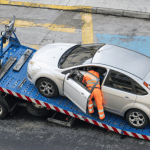
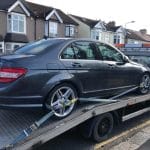
Most recovery jobs are simple. The car is at the kerb, the truck arrives, the car goes on the back, everyone gets on with their day.
The ones that go wrong go wrong for a reason nobody thinks about until it is happening: the truck physically cannot get to where the car is. Not unwilling, not busy — cannot. A recovery vehicle is a large, heavy, tall lorry, and a surprising number of the places cars end up were designed on the assumption that only cars would ever go there.
This is the post nobody in the trade writes, because it is about limits rather than capability. It is also the single most useful thing you can know before you ring anyone.
Height is the one that stops everything
A height barrier is absolute. There is no negotiating with a steel bar.
Multi-storey and underground car parks are the obvious case. Entrance barriers are commonly set at around two metres, which is comfortable for a van roof box and impossible for a recovery truck. Retail parks, station car parks, hospital sites and apartment blocks use the same thing, sometimes at the entrance to a whole site rather than a single deck.
Then there are low railway bridges, which Sheffield has plenty of. A signed height is not advisory. A driver who takes a truck under one because it looks fine is committing an offence and doing real damage. If your car is beyond a low bridge, the route in matters as much as the address.
The answer in these situations is almost always the same: the car comes out to the truck. That might mean rolling it down a deck and out to the street, or moving it a short distance with something smaller. It is a solvable problem — but only if it is known about before the lorry sets off. Our guide to recovery from car parks covers how those jobs are usually run.
Weight and width
Weight limits exist on bridges and on residential streets, and they apply to loaded lorries regardless of how convenient it would be to ignore them. A weak bridge sign is a structural statement, not a preference.
Width is a quieter problem. Terraced streets with parked cars on both sides leave a channel that a car fits through easily and a lorry does not, and the real difficulty is often not driving in but getting back out. Reversing a loaded truck the length of a street, at night, past somebody’s wing mirrors, is how minor jobs become expensive ones.
Rural lanes are the same story with stone walls instead of parked cars. The lanes out past Ringinglow and over towards the Peak are lovely and completely unforgiving of a vehicle that has committed to them.
Permission, not just physical access
Some places a truck can reach, it still cannot enter without someone opening it.
Gated estates and private roads with fob access. Barriered business parks after hours. Bollards that drop for residents. Hospital and university sites with controlled entrances. Private land where the owner has to agree to a lorry coming on.
None of these are unsolvable, but they need a phone number or a person, and finding that person at two in the morning is not always possible. If your car is behind a barrier that someone else controls, work out who that someone is early.
Space to work, not just space to arrive
This is the one people miss most. A flatbed does not just need to reach the car. It needs to stop somewhere safe, tilt its deck back, and have several metres of clear ground behind it to run the car up.
A car wedged nose-first into a tight parking bay with a wall behind it, or parked in the middle of a row with vehicles either side, is reachable and not immediately loadable. Sometimes it has to be brought out first, which is what skates and a winch are for.
Ground matters too. A truck on soft verge or waterlogged field is one recovery away from becoming a second recovery. Our guide to winching a stuck vehicle out covers how that gets handled when the car is off the tarmac.
Sheffield’s own version of the problem
Two things make this city particular.
The first is the hills. Loading a car onto an inclined deck on a road that is already steep changes the geometry of the whole job, and on the sharper gradients around Gleadless Valley, Crookes and the streets running down to the Don, the sensible answer is often to move the car a short way to somewhere flatter before loading rather than fighting the slope.
The second is the housing stock. Long terraced streets, narrow back lanes, on-street parking on both sides for a mile at a time. It works fine for cars. It is why the access question gets asked before a truck is assigned.
Motorways are a special case
If a vehicle is stopped in a live lane, that is a National Highways and police matter before it is a recovery matter. They will get it to a place of safety first. Once the car is on a hard shoulder, in an emergency area or off the carriageway, normal recovery resumes. Our guide to stopping on a motorway covers what you should be doing while that happens, and the short version is get out of the car, get behind the barrier, and stay there.
What actually helps: tell us the access when you ring, not just the postcode. Height barrier, gate, narrow street, steep hill, underground level, field, multi-storey — any one of those changes what we send and how long it takes. We cover Sheffield and South Yorkshire around the clock and we would far rather answer three extra questions on the phone than send the wrong vehicle. Call DK’s Recovery on +44 7867 860723.
If it cannot be moved tonight
Occasionally the honest answer is that the car is somewhere nothing can reach until the barrier is unlocked, the ground dries out or the street empties in the morning. In that case the question becomes whether it is safe and legal where it is standing, which is what our guide to leaving a car overnight in Sheffield is about.
Frequently asked questions
Why can a recovery truck not follow my car into an underground or multi-storey car park?
Almost never. Height barriers at the entrance are typically set around two metres, and a flatbed is far taller than that even before you consider the ramps of the deck. The usual answer is to get the car down to ground level and out to the street — pushed, or moved by a smaller vehicle — and load it there. Tell us it is a multi-storey when you ring, because it changes what we send.
What should I tell the recovery firm when I call?
Where the car is precisely, whether it rolls and steers, whether the wheels turn, whether it is automatic, and anything about the access — a barrier, a height restriction, a gate, a narrow street, a steep hill, a field. The access detail is the part people leave out, and it is the part that decides which vehicle turns up.
Can you recover a car from a field, a farm track or a verge?
Usually, but it is a different job from a roadside pick-up. It needs winching, ground that will take the weight of the truck, and somewhere to work from. Soft ground after rain is the limiting factor more often than distance is. It is worth saying on the phone that the car is off the tarmac rather than letting the driver discover it.
What happens if the truck cannot physically reach my car?
We work out how to get the car to the truck instead. That can mean winching it out, moving it a short distance on skates or by hand to a point with clearance, or using a different vehicle for the first stage. What we do not do is arrive, look at it and leave, which is why the access questions get asked at the booking rather than at the kerb.
Can you get down a narrow terraced street with cars parked both sides?
Often yes, but not always, and reversing a loaded flatbed out of a dead end is not something to discover at midnight. If your street is tight, say so. Sometimes the practical answer is to move the car to the end of the road first, and that is a decision better made before a lorry is committed to the street.
Can a vehicle be recovered from a live motorway lane?
Not by a recovery firm arriving on its own. A vehicle stopped in a live lane is a National Highways and police matter first, and they will get it to a place of safety before anything else happens. Once it is on a hard shoulder, in an emergency area or off at a junction, normal recovery takes over.