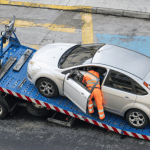
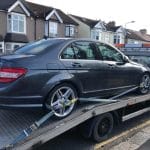
Electric cars break down less often than petrol ones, and when they do the recovery is less forgiving. There is no jump lead solution to an empty battery and no towing it round the corner — almost every EV that stops needs a flatbed.
DK’s Recovery covers Sheffield and South Yorkshire 24 hours a day and recovers electric vehicles on a flatbed. Call 07867 860723, or see our vehicle recovery page.
Why an EV cannot simply be towed
On an electric car the wheels and the motor are permanently connected. Turn the driven wheels and the motor turns with them, generating current back into a system that is not expecting it. That can damage the motor or the power electronics, and the bill for either is not small.
So an EV goes on a flatbed with all four wheels off the road. Where a flatbed genuinely cannot reach it, the driven wheels go on dollies instead. What does not happen is a conventional tow.
The three things that actually strand EVs
1. A flat 12V battery
This is the most common one and it surprises people. Every electric car has an ordinary 12V battery running the locks, the computers and the dashboard. If it dies, the car will not power up, unlock or move — with a completely full traction battery.
Worse, with no 12V power there is usually no way to release the parking pawl, so the car cannot even be rolled. Our guide to a flat battery covers what to check first.
2. Running out of charge
The car warns you, reduces power, then stops. There is no equivalent of a can of fuel — mobile charging exists but is rare in the UK, so in practice the car is recovered to a working charge point or to your home charger.
Worth knowing: rapid chargers being out of order is a common cause. Plan around the possibility that the charger you were relying on is not working, particularly on longer runs.
3. Tyres
EVs are heavy and instant torque wears tyres faster than most drivers expect. Many carry no spare at all, only a sealant kit — and sealant cannot fix a sidewall. A puncture on an EV is more likely to end in recovery than the same puncture on a petrol car.
After a collision
A damaged high-voltage battery pack needs treating with more caution than a fuel tank. Damage inside the pack can develop into thermal runaway hours — occasionally days — after the impact, so damaged electric vehicles are handled carefully and kept clear of other vehicles and buildings.
If you have been in a collision in an electric car, say so when you report it. It changes how the scene is treated and where the vehicle can be taken. Our accident recovery page covers the rest of the process.
Transport mode, and why it matters
Many EVs have a transport, tow or service mode that releases the parking pawl so the car can roll onto a bed. It is usually several menus deep, and it usually needs the car to have 12V power to reach it.
If your car still powers up, it is worth finding that setting before help arrives — the handbook will name it. If it does not power up, that is fine, it just means the winch does the work.
If you need an electric or hybrid vehicle moved now, our EV recovery service covers Sheffield 24 hours a day, on a flatbed with all four wheels off the ground.
What to tell us when you call
- Make and model, and that it is electric or hybrid.
- Whether the car powers up at all — dash lights, locks, screen.
- Roughly what range or percentage is showing, if any.
- Whether it will select neutral or transport mode.
- Where it is — and if it is in a car park, which level, because height limits rule out a flatbed.
- Whether it has been in a collision.
Common questions
Can an electric car be towed?
Not in the normal sense. With the driven wheels turning on the road the motor acts as a generator, which can damage the motor or the power electronics. Electric and hybrid vehicles go on a flatbed as standard, and where that is impossible the driven wheels must be lifted clear on dollies.
What happens if my EV runs out of charge?
It slows, warns you repeatedly, then stops. Unlike a petrol car there is no jerry can solution – mobile charging is rare in the UK, so in practice it is recovered to a charge point or to your home charger. Say how much range is showing when you call.
My electric car is completely dead and will not unlock. Why?
Almost certainly the 12V battery rather than the traction battery. Every EV has a conventional 12V battery running the locks, computers and dash, and if it dies the car will not power up even with a full main battery. See our guide to a flat battery for what to check.
Can you put an EV in neutral to move it?
Usually only when the car has power. Most EVs need the 12V system live to release the parking pawl, and many have a transport or tow mode buried in the settings. With a dead 12V there is often no neutral at all, which is why the flatbed comes out.
Is a damaged EV battery dangerous after a crash?
It can be. A damaged high-voltage pack can go into thermal runaway hours or even days after the impact, so damaged EVs are handled carefully and kept at a distance from other vehicles and buildings. Always mention it is an EV when you report an accident.
Do you charge more to recover an electric car?
The job is priced the same way as any other – distance, time of day and how difficult it is to load. An EV always needs the flatbed, so it is quoted on that basis rather than as a wheel-lift job.
Electric car stuck in Sheffield?
Tell us it is an EV when you call and the right vehicle comes first time. 07867 860723 — 24 hours a day.