There are two completely different AdBlue problems, and they get mixed up constantly. One is AdBlue going into the diesel tank, which is a contamination job. The other, far more common, is the AdBlue tank simply running dry — and then the car refusing to start.
This post is about the second one. If you have poured the wrong thing into the wrong hole, our guide to putting the wrong fuel in your car covers that, and the short version is do not start the engine.
The countdown is designed behaviour, not a breakdown
This is the part that catches people out, and it is worth being blunt about. A modern diesel with selective catalytic reduction is approved to meet an emissions standard on the condition that the system keeps working. Take the AdBlue away and it no longer does. So the manufacturer builds in an escalating set of warnings and, at the end of them, a refusal to restart.
That is not a fault code you have been unlucky enough to hit. It is the car doing exactly what it was engineered to do, to a driver who has been told for several weeks that this was coming.
Which is why it strands people so effectively. A breakdown is sudden. This is a slow, announced, entirely avoidable event that happens at the worst possible moment, because the moment it happens is whenever you next turn the engine off.
What the warnings actually look like
They escalate, and the wording differs by manufacturer, but the shape is consistent:
First, a message with a range attached — refill AdBlue, so many miles remaining. On many cars this appears with well over a thousand miles left. It is easy to dismiss because nothing changes about how the car drives.
Then the range figure starts appearing every time you start the car, the warning goes amber or red, and on some models you get a reduced power or limp behaviour. Our guide to limp mode and whether you can keep driving covers what that actually means for the rest of the journey.
Finally the display says something like engine start not possible, or shows zero miles. At that point the engine will keep running while it is running. Switch it off and it is staying off.
The practical advice is embarrassingly simple: treat the first warning as the job, not the last one. The difference between a bottle of fluid at a supermarket and a recovery truck on a Sunday night is entirely a matter of when you paid attention. Our guide to which dashboard warning lights mean stop now sets out where this one sits against the ones that mean pull over immediately.
If it has already refused to start
Add AdBlue. That is genuinely the fix, in most cases, and it is worth trying before you conclude the car is broken.
Two things stop it working. The first is not adding enough — a token two litres often will not clear it, because the system wants to see a meaningful refill before it accepts one. The second is not giving it the wake-up procedure the handbook asks for, which on some cars is ignition on for a minute or two without cranking, and on others a short drive before the message clears.
If you have added a proper amount, followed the procedure and it still will not start, you are past a top-up and into a fault — a level sensor, the pump, a heater, a blocked injector, or crystallised urea in the delivery line. Those are garage jobs, and the car is not going anywhere under its own power.
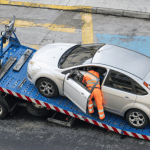
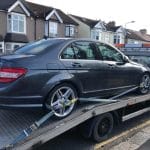
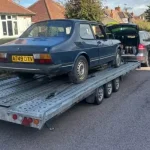
Where it is worth calling us: when the car will not restart, has to be moved off a forecourt, a car park or a driveway, and needs to get to a garage that can read the fault properly. A no-start diesel goes on a flatbed, not on a rope. We cover Sheffield and South Yorkshire around the clock — call DK’s Recovery on +44 7867 860723. Our guide to getting a car to a garage when it cannot be driven explains how that usually works.
Topping up without creating a bigger problem
AdBlue is cheap, widely sold and easy to handle. The ways people turn it into an expensive afternoon are all avoidable.
Use the right filler. It is normally a blue cap, either beside the diesel filler, under the bonnet or in the boot. If you are peering at it wondering, stop and check the handbook.
Use fluid that meets ISO 22241. The bottles say so. This is not a place for a mystery container of something urea-ish from the back of a garage.
Do not use a random funnel. Contamination is the thing that kills these systems. Diesel, oil, screenwash or dirt getting into the AdBlue tank causes damage that costs many times what the fluid does. The pouring nozzles on the bottles exist for a reason.
Wipe up spills. It is not dangerous, but it dries into a white crystalline crust and it does paint no favours.
Cold weather
AdBlue freezes at about minus eleven degrees Celsius. Vehicles that use it have heated tanks and lines, so a hard frost is not a problem in itself and the system thaws as the car warms up. What cold weather does do is coincide with the season when everything else is going wrong at once, which is covered in our guide to winter breakdowns. A bottle stored in an unheated garage may be frozen solid when you want it; bring it inside first.
The delete and emulator question
It gets advertised, so it is worth answering directly. Having the system removed or an emulator fitted to a road car is not a legal fix. The MOT inspection manual treats emission control equipment fitted by the manufacturer that is missing, obviously modified or obviously defective as a major defect — a fail — and selective catalytic reduction components are visible enough for a tester to look at. It is also an undeclared modification as far as an insurer is concerned, which is the sort of detail that surfaces at the worst possible time.
A tank of fluid costs a few pounds. That comparison usually ends the discussion.
Frequently asked questions
Why will my car not start when the AdBlue is empty?
Because it is designed not to. Diesel cars with selective catalytic reduction have to keep their emissions system working to stay within the standard they were approved to, so once the AdBlue tank reaches zero the engine management prevents a restart. It is not a breakdown or a fault. The car will keep running until you switch it off, and then it will not fire again until AdBlue is added.
How much AdBlue do I have to add before it will start?
More than a splash. Most manufacturers set a minimum before the sensor recognises a refill, commonly in the region of five to ten litres, and some cars want the ignition on for a minute or two, or a short drive, before the countdown clears. Check the handbook for your model rather than guessing, because adding two litres and getting nothing is what makes people think the car is broken.
Can I top up AdBlue myself?
Yes. It is sold at fuel stations, motor factors and supermarkets, the filler is usually a blue cap next to the diesel filler or in the boot, and the bottles have a nozzle designed to fit it. Use fluid marked as meeting ISO 22241 and do not decant it through a funnel that has had anything else in it.
Does AdBlue freeze or go off?
It freezes at around minus eleven degrees Celsius, which is why vehicles that use it have heated tanks and lines. A frozen tank on a cold morning is normal and thaws as the car warms up. It also has a shelf life, so a part-used bottle that has sat in a hot garage for two years is worth replacing rather than pouring in.
What happens if I put AdBlue in the diesel tank by mistake?
Stop, do not start the engine, and get it recovered. AdBlue is a urea solution and it is corrosive to parts of a fuel system. Putting it in the diesel tank is a contamination job that needs draining and flushing, not a top-up you can dilute your way out of.
Is it legal to have the AdBlue system removed?
No, not for a car used on the road. The MOT inspection manual lists emission control equipment fitted by the manufacturer that is missing, obviously modified or obviously defective as a major defect, which is a fail, and selective catalytic reduction parts are among the things a tester can see. It can also affect your insurance, because it is a modification that has not been declared.