There are two people who search for this, and they want opposite things. One has come out to find a sticker on their own windscreen saying the council believes the car is abandoned. The other has had somebody else’s wreck rotting outside their house for three months and wants it gone.
This covers both, because the process is the same from either end.
What the council can actually do
Local authorities have a duty under the Refuse Disposal (Amenity) Act 1978 to remove vehicles abandoned without lawful authority on land in the open air or on roads. The Act has been amended a good deal since 1978, and the practical detail — how long a notice runs, how it is served, what happens next — is set by each council rather than fixed nationally.
The one distinction worth knowing is that the process on a road is not the same as the process on private or open land. On a road the authority has more direct powers; elsewhere there is a notice step involving the occupier of the land.
For the actual timescales that apply here, Sheffield City Council publishes its own abandoned vehicle procedure, and that is the version that governs your car rather than anything you read on a national site.
If the notice is on your car
Do not ignore it, and do not assume it is a mistake because the car is taxed. Tax is one factor among several; a car can be taxed and still meet a council’s criteria for abandonment.
What tends to trigger it: the vehicle appearing untaxed or without an MOT, sitting in one spot for weeks, obvious damage, flat tyres, missing plates, a build-up of leaves and dirt, or a neighbour reporting it.
The fix is usually straightforward and it is mostly about demonstrating the car is not abandoned:
Contact the council immediately using the reference on the notice, and say the vehicle is yours and is not abandoned.
Move it. Even a few hundred yards, and ideally off the road entirely. A car that has demonstrably moved is a much harder case to make against.
Sort the paperwork. Tax it, or get it onto a driveway and declare a SORN. Note that a SORN does not protect a vehicle parked on a public road, which is covered in our guide to being clamped by the DVLA for no tax.
Make it look owned. Clean it, put the wheels back on, remove the tarpaulin. It sounds trivial and it is exactly what the assessment looks at.
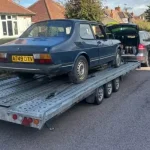
If it will not move, that is the real problem. A car that has stood long enough to attract a notice has often seized brakes, flat tyres or a dead battery, and it cannot simply be driven off. We move vehicles like that on a flatbed to a driveway, a garage or wherever you need, which resolves the notice at a stroke. Call DK’s Recovery on +44 7867 860723, and our guide to bringing a car back after months standing covers what else to expect.
If it is somebody else’s car outside your house
Report it to the council rather than the police, unless you have reason to think it is stolen or dangerous, in which case call the police as well.
What makes a report effective is detail. The registration, the make, model and colour, exactly where it is, how long it has been there, and whether it is taxed — which anyone can check free on the DVLA vehicle enquiry service. Photographs help. So does a note of the date you first noticed it, because “a while” is not evidence and “since 4 June” is.
Then be patient in a specific way: the council has to follow a process that gives the owner a chance to respond, and that takes weeks rather than days. A car that reappears with new tax is not a failure of the system; it is the system working.
What it is not
An abandoned vehicle notice is not a parking ticket, not a DVLA clamp, and not a police seizure. Those are three different processes with different bodies behind them, and our guide to what to do when your car is not where you left it sets out who is likely to have taken a vehicle in each case.
It is also not a fine. There is no penalty attached to the notice itself. The cost only arrives if the vehicle is removed and you then want it back, at which point removal and storage charges apply, and those do mount.
If the car genuinely is finished
Plenty of these notices land on cars whose owners have quietly given up on them. If that is the honest position, the answer is not to leave it and hope. Scrapping it properly at an Authorised Treatment Facility takes an afternoon, ends the liability, and is covered in our guide to scrapping a car properly. Leaving it to be removed costs more and achieves the same thing with worse paperwork.
Frequently asked questions
What gives the council the power to remove an abandoned car?
The Refuse Disposal (Amenity) Act 1978 places a duty on local authorities to remove vehicles abandoned without lawful authority on land in the open air or on roads. The Act has been amended several times, and the practical notice periods and procedure are set by each council rather than fixed nationally.
There is an abandoned vehicle notice on my car but it is taxed.
Tax is only one of the factors assessed. A vehicle can be taxed and still meet a council’s abandonment criteria if it has sat in one place for weeks, has flat tyres or obvious damage, or has been reported. Contact the council using the reference on the notice, and move the vehicle if you possibly can.
What is the quickest way to resolve a notice?
Move the car, ideally off the road entirely, and tell the council it is yours and not abandoned. A vehicle that has demonstrably moved is far harder to classify as abandoned. Sorting tax or a SORN and making the car look cared for help too.
My car will not move. What then?
That is the common situation, because a car that has stood long enough to attract a notice often has seized brakes, flat tyres or a dead battery. It can be moved on a flatbed to a driveway or garage without being driven, which resolves the notice.
How do I report a car dumped on my street?
Report it to the council rather than the police, unless you think it is stolen or dangerous. Give the registration, make, model, colour, exact location, how long it has been there, and whether it is taxed, which anyone can check free on the DVLA vehicle enquiry service. Photographs and the date you first noticed it both help.
How long does it take for the council to remove one?
Weeks rather than days, because the owner has to be given an opportunity to respond. If the car reappears taxed and moved, that is the process working rather than failing.