Most advice about car accidents stops at the roadside. This is about what happens to the vehicle after that — how it gets loaded, where it goes, who pays while it sits there, and how the decision gets made about whether you ever drive it again.
If your car cannot be driven after a collision, DK’s Recovery covers Sheffield and South Yorkshire 24 hours a day for accident recovery and vehicle recovery. Call 07867 860723.
How a damaged car actually gets loaded
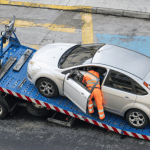
A car that still rolls and steers can be winched onto a flatbed in minutes. One with a collapsed corner, a seized wheel or a locked steering column cannot, and forcing it does more damage on the way to the garage than the accident did.
In that case the operator uses skates — small wheeled dollies that go under the damaged corners — or lifts the vehicle rather than dragging it. It takes longer and it is the right call. If a recovery driver is willing to drag a badly damaged car onto a truck on its own wheels, that is worth questioning.
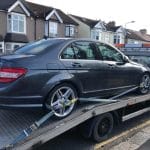
Electric and hybrid cars go on a flatbed as standard. Towing an EV with its driven wheels on the road can damage the motor, and a battery pack damaged in a collision needs careful handling and space around it.
Take your belongings before it goes
This is the step people regret skipping. Once the vehicle is on a truck heading for a compound, retrieving anything from it means arranging a visit, sometimes to a site an hour away, sometimes with a fee.
Take documents, both sets of keys if you have them, phone and chargers, sat-nav, dash cam and its memory card, child seats, prescription glasses, anything of value, and anything in the boot you would miss. Items left in a vehicle are generally not covered by motor insurance, and after a write-off the car may be disposed of with them inside.
The question of who pays for the recovery itself is a separate one, and it is worth understanding before you sign anything at the roadside. Our guide to who actually pays after a non-fault accident explains how insurer-arranged recovery and credit hire work.
Where the car goes first, and why it matters
You have three realistic destinations: a garage of your own choosing, a repairer your insurer nominates, or a storage compound while you decide. In a non-fault claim you are not obliged to use the insurer’s recommended repairer — you can nominate your own.
The one to avoid is drifting into option three without meaning to. Storage accrues daily, and while the other driver’s insurer is usually liable in a non-fault claim, arguments about storage bills are common. Deciding the destination quickly, even provisionally, saves money and time.
The engineer’s inspection
Once the claim is open and the vehicle is somewhere reachable, the insurer sends an engineer to assess it. That inspection decides everything that follows, and it cannot happen while the car is in an unconfirmed location. This is the practical reason to get the vehicle somewhere sensible on day one.
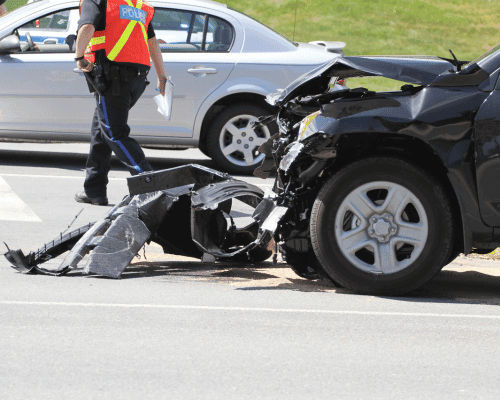
The engineer compares the cost of repair against the car’s pre-accident value. If repair costs approach or exceed that value, it is written off — which does not always mean the damage is dramatic. An older car with modest but awkward damage is written off routinely.
Getting the car back out again has its own process, and storage charges run while you work it out. Our guide to what happens after your car has been recovered covers release, storage and the paperwork.
What the write-off categories mean
The UK uses four salvage categories, and they are frequently misunderstood:
- Category A — scrap only. The entire vehicle must be crushed, including every part.
- Category B — the body shell must be crushed, but serviceable parts may be reclaimed and resold.
- Category S — structural damage that can be repaired. The car can legally return to the road once properly repaired.
- Category N — non-structural damage that can be repaired. Also road-legal after repair, though “non-structural” can still mean significant work.
With S and N you can often buy back the salvage and repair it yourself, which is worth considering on a car you know well. The category stays on the vehicle record permanently and reduces resale value, so it is a decision to make with open eyes.
If it is repairable, what happens next is a body shop rather than a salvage yard. Our guide to car accident repairs covers that side.
If you are keeping the car
Where the vehicle is repairable, it moves from wherever it has been sitting to the repairer. That is a second recovery job, and it is worth asking who is arranging and paying for it before assuming someone else has it in hand.
Accidents on the motorway
On the M1 or a dual carriageway the sequence changes. Get out of the passenger side if you can, get behind the barrier, and call 999 first if anyone is hurt or a vehicle is in a live lane. Recovery from a live carriageway is a different job with traffic management involved — see our breakdown recovery page for how that works.
Common questions
Can I get my belongings out of the car before it is taken?
Yes, and you should. Take documents, keys, electronics, chargers, child seats and anything of value with you at the scene. Once a vehicle is in storage or at a compound, getting access again means arranging a visit, and items left inside are not usually covered by anyone’s insurance.
Where will my car be taken after an accident?
Wherever you tell us – your own garage, a body shop, your home, or a storage compound if you have not decided yet. In a non-fault claim you are not obliged to use the repairer your insurer recommends.
Who pays for storage while my car waits?
In a non-fault claim the other driver’s insurer is generally liable. Storage accrues daily, so the single best thing you can do is decide where the vehicle is going quickly, even if the repair itself has to wait.
What do the write-off categories mean?
Category A means the vehicle must be crushed entirely. Category B means the body shell is destroyed but some parts may be salvaged. Category S means structural damage that is repairable. Category N means non-structural damage that is repairable. S and N cars can legally return to the road once repaired and re-registered.
Can I keep my car if the insurer writes it off?
Sometimes. With Category S and N you can often buy back the salvage and repair it privately, though the write-off stays on the vehicle’s record and affects resale. Category A and B vehicles cannot return to the road.
How long does it take to find out if my car is repairable?
An engineer usually inspects within a few working days of the claim being opened. The clock only starts once the vehicle is somewhere the engineer can reach it, which is another reason not to leave it sitting at the roadside or in an unconfirmed location.
Need a damaged car moved in Sheffield?
Tell us where it is, where it needs to go and what state it is in. Call 07867 860723 — any hour, across Sheffield and South Yorkshire.
A recovered stolen vehicle follows a different path from an accident-damaged one, and the first decisions are yours rather than the insurer’s. Our guide to what happens when a stolen car is found covers it.